The Living Goods Model: A Sustainable System for Defeating Diseases of Poverty
In the last 100 years we have acquired the medical know-how to stop the deadly afflictions of malaria, diarrhea and TB. Yet, billions of dollars and a half century of effort have failed to prevent 10 million children from dying every year from these easily preventable diseases. It’s not medical solutions we lack, but the efficient, scalable, sustainable means of delivering them. That is the gap that Living Goods aims to fill.
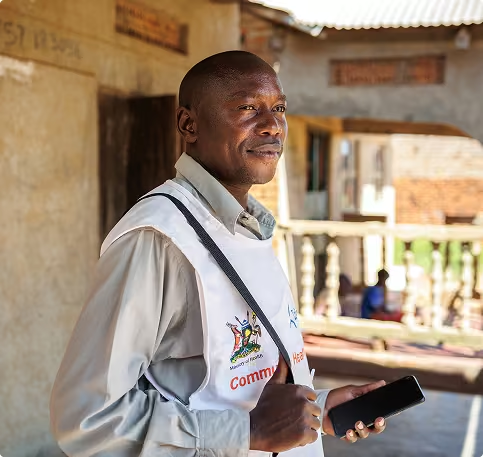
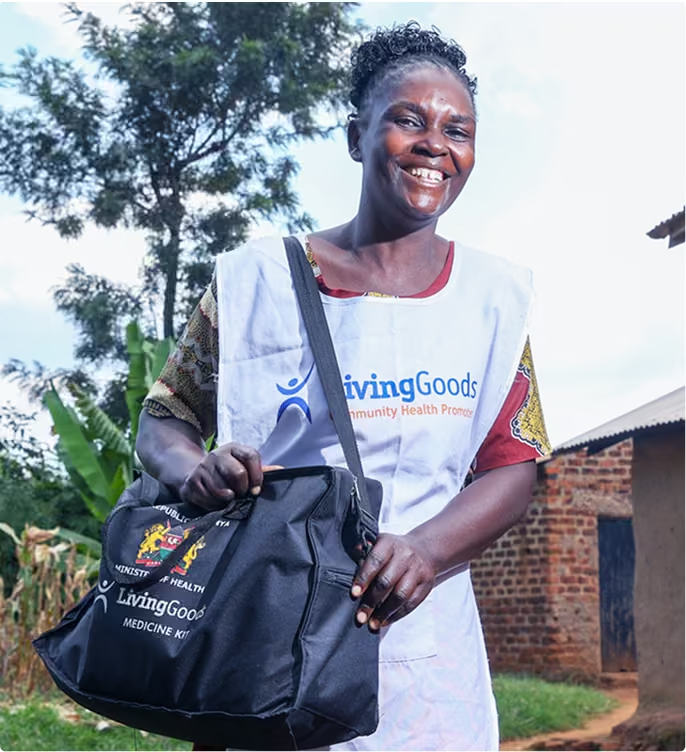
Living Goods is an Avon-like network of door-to-door Health Promoters who make a modest income selling essential health products at prices affordable to the poor. The model combines the latest and best practices from the worlds of micro enterprise and public health to create a truly sustainable system for defeating diseases of poverty. Living Goods (LG) reduces illness and death by significantly improving access to simple, proven health interventions in the many places these are scarce. It also improves livelihoods by providing women a reliable source of income as Living Goods Health Promoters, by keeping wage earners healthy and productive, and by averting costly medical treatments.
Health Focus
Living Goods focuses on a short list of diseases that account for over two thirds of mortality and can be prevented and/or treated at very low cost. These include malaria, diarrhoeal disease, worms, and TB. LG Health Promoters also provide basic family planning and reproductive health services. They market a diverse basket of goods anchored by essential items emphasizing prevention like bed nets, condoms and water treatment, and complimented with home and personal care items to enhance their income and sustainability (see the product list).
Best Practice Micro-Franchising
Living Goods employs all the key characteristics of successful franchises:
- Methodically screened agents
- Strict quality monitoring and follow-up training
- Uniform branding and product mix
- Effective promotions
- Low cost of goods achieved through scale
- Stiff penalties for violating the rules (including expulsion)
Avon has employed this system to build an $8 billion business in over 100 countries through over five million agents. The Avon model succeeds in countries as diverse as the US and the Ukraine, Turkey and Thailand. LG believes this model can be used to achieve the same scale, financial efficiency and geographic reach in service of healthcare for the poor.
Like Avon, the Living Goods model has powerful benefits for micro entrepreneurs: 1) A proven business-in-a-box system heavily supported with training, marketing and coaching 2) Low start up costs of just $100-$250 supported with simple low-cost financing, and 3) Flexible hours and lifestyle: Sellers can work on their own schedule and in their own communities. This is particularly valuable to women who often must juggle the competing demands of family, farm, and household.
Providing effective, sustainable incentives to village-based health workers is at the core of the Living Goods model. Through these simple economic incentives LG creates a virtuous circle. The more profitable the Health Promoter is, the more time she will invest in her work, and thus the greater the health impact she will have.
Highly Efficient and Truly Sustainable
A fundamental characteristic of the Living Goods model is its ability to deliver public health outcomes at a fraction of the cost of traditional approaches.
In fact, Living Goods aims to become fully financially self-sufficient in five to six years. Living Goods key strategies for sustainability include:
- Leveraging existing resources, assets and partnerships wherever possible
- Building significant scale economies
- Cutting out layers of middlemen in health products distribution
- Maintaining rigorous cost discipline, and most importantly…
- Focusing obsessively on the productivity and livelihoods of its Health Promoters.
Providing effective incentives to village-based health workers is at the core of the Living Goods model. Through the incentive of ownership, LG creates a virtuous circle. The more the Community Health Promoter earns, the more time she will invest in her work, and thus the greater health impact she will have.
Depending on local circumstances, LG may operate as a highly efficient non-profit social enterprise, as a contractor to government health ministries, or even as a for-profit business. Under any of these scenarios this model can deliver exceptional public health ‘returns’ on an annual investment of as little as $1 per capita or less.
Of course the Living Goods model is not a cure-all for primary care, but it can meaningfully improve health in many currently underserved communities, and thus free limited public resources to focus on other needy areas.
.
Click here to learn more about >
Target Markets
Leveraging Local Partners
Branding and Communications
Competitive Pricing
Distribution and Monitoring
Strict Controls